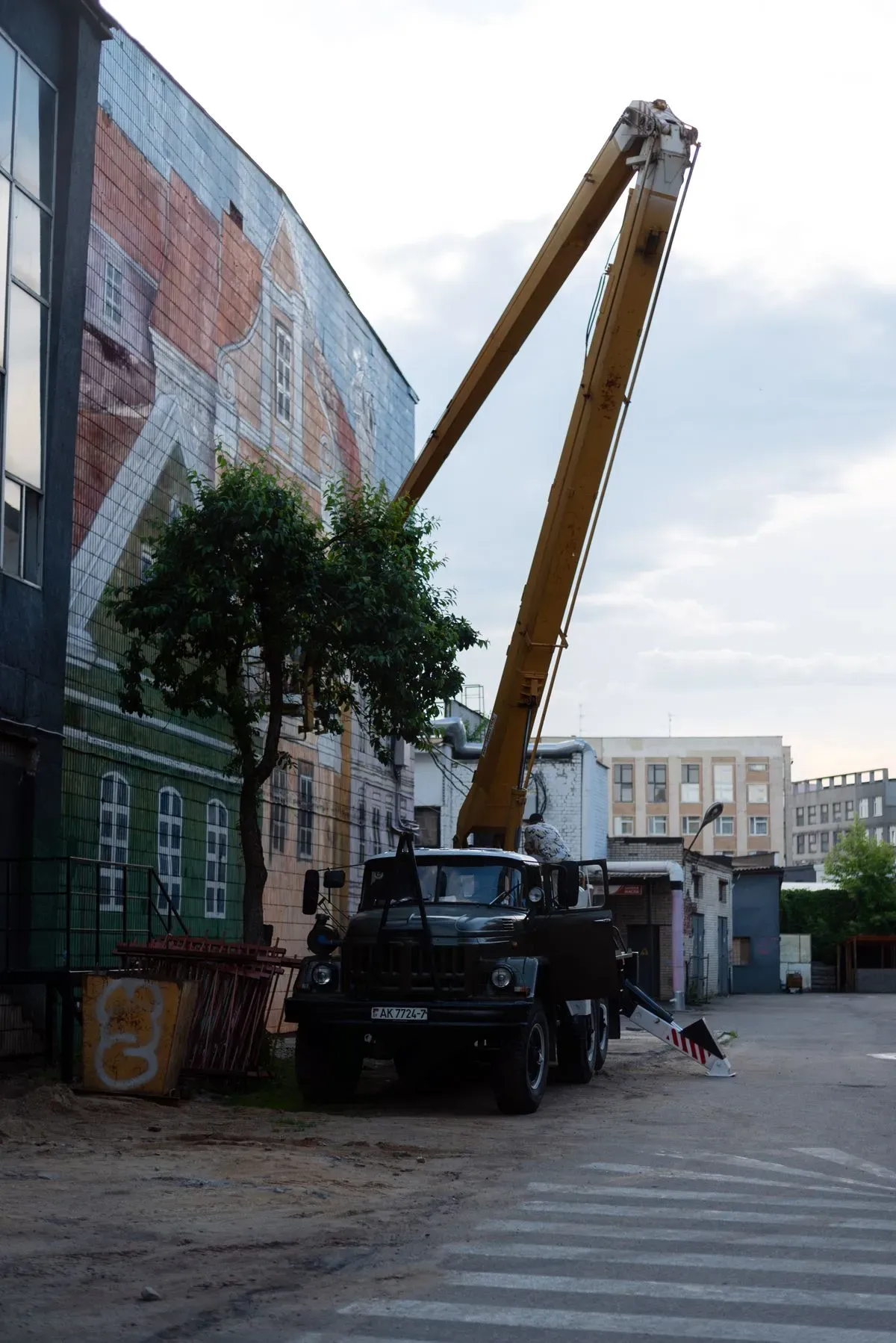
Most lifts for homes and small businesses in Chicago use a mobile crane: a truck crane, an all-terrain crane or a boom truck. Crawler and tower cranes belong on big construction sites. Here is what each type does, so you know what a company means when it names one.
What types of cranes are there?
The main types of cranes are mobile cranes (truck cranes, all-terrain and rough-terrain cranes), boom trucks, crawler cranes, tower cranes and small spider or mini cranes. They differ in how they get to the site, how fast they set up, how much ground they need and how far and how high they can reach.
What is a mobile or truck crane?
A mobile crane is a crane that moves under its own power and lifts from outriggers, and a truck crane is a mobile crane mounted on a truck carrier. It drives to the site, spreads its outriggers and is ready to lift without assembly on site. That quick set-up is why truck cranes handle most single-day lifts, such as a rooftop unit, a beam or a hot tub.
What is the difference between all-terrain and rough-terrain cranes?
An all-terrain crane can drive on public roads at road speed and still handle rough ground on a job site. A rough-terrain crane has big tires for dirt, mud and uneven ground, but it is usually not driven on the street and has to be hauled to the site. For a lift on a Chicago street, an all-terrain or truck crane is the more common choice. Rough-terrain cranes show up on large construction sites.
What is a crawler crane?
A crawler crane sits on tracks, like a bulldozer, instead of wheels. The tracks spread its weight, so it can move around a site with a load and work on softer ground. Crawlers are hauled in pieces and put together on site, which takes time and room. They suit big, long jobs, such as heavy steel or bridge work, rather than a one-day lift.
What is a tower crane?
A tower crane is the tall, fixed crane you see over high-rise construction downtown. It is anchored to a base and stays for months, with a long horizontal jib that reaches across the site. It is not used for single lifts. Putting one up and taking it down are major jobs of their own, with their own permits.
What is a boom truck?
A boom truck is a truck with a crane mounted on its bed, so it can carry the load and lift it. It is smaller than a truck crane, with less reach and capacity, but it sets up fast and fits on narrow streets and alleys. Boom trucks are common for condensers, signs, glass, roofing material and other lighter lifts.
What is a mini or spider crane?
A spider crane, or mini crane, is a small crane on tracks with fold-out legs that can fit through a doorway or a narrow gangway. It is used where a big crane cannot reach, such as inside a building, in a courtyard or on a tight back yard. Its capacity is small compared with a truck crane. Prices are usually quoted job by job; no publisher we found lists a figure.
What is the difference between a telescopic and a lattice boom?
A telescopic boom slides out in sections, one inside the other, like a telescope. It sets up quickly and is the usual boom on truck and all-terrain cranes. A lattice boom is built from a steel frame of crossed bars, assembled in sections on site. It is lighter for its length and can lift heavy loads high, so it is common on crawler cranes and big jobs.
Do I need a crane or will a forklift or telehandler do?
A forklift or telehandler will do when the load is light enough, the ground is firm and the machine can drive right up to the spot. A telehandler can put pallets onto a low roof or a second floor. It cannot lift a load over a house, place it far back in a yard or set a unit high on a roof. When the load has to go over or past something, you need a crane.
Want a price for your own lift? Tell us what needs to move, roughly how heavy it is and where the crane could set up, and we will send a written quote with the crane size, the hours and the price. Call or text (312) 964-8313.